
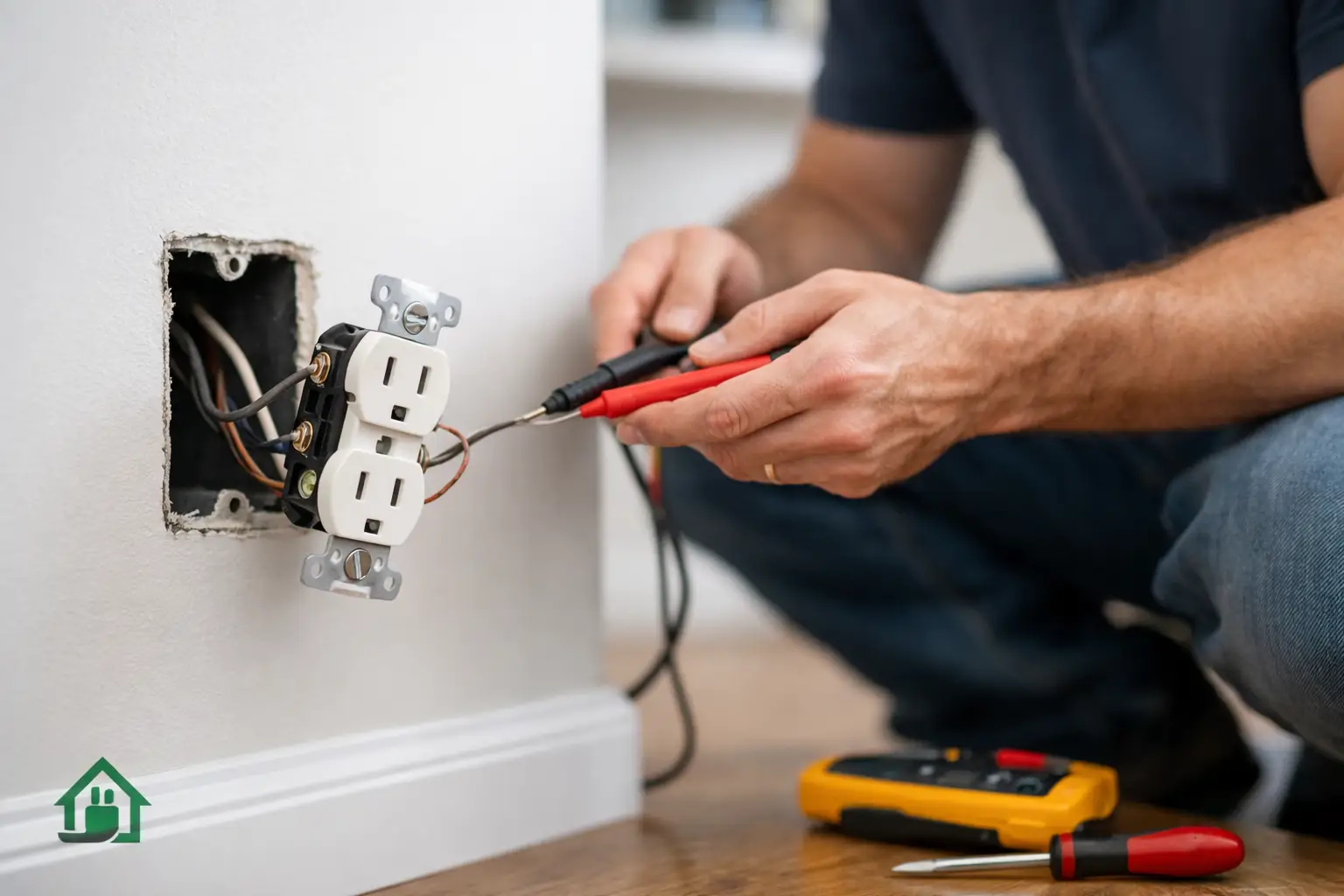
A dead outlet is rarely just an inconvenience. It can interrupt a home office, leave a garage door opener without power, shut down equipment at a business, or point to a wiring issue that deserves attention. Electrical troubleshooting for dead outlets starts by identifying what is affected, then ruling out the safe, simple causes before a licensed electrician tests the circuit.
The key is knowing where the homeowner or property manager should stop. Resetting a tripped safety device is reasonable. Removing outlet covers, working inside a panel, or repeatedly resetting a breaker that will not hold is not. A dead receptacle may be a minor reset issue, but it can also be the first visible sign of a loose connection, overloaded circuit, moisture problem, or failing electrical component.
Start Electrical Troubleshooting for Dead Outlets Safely
Before assuming the outlet itself has failed, plug in a lamp, phone charger, or other device you know works. This confirms the problem is the outlet rather than the item that was plugged into it. Do not use a damaged cord or a device that has been overheating.
Next, check the nearby outlets and lights. Many outlets are connected in a series of locations on the same branch circuit. If several outlets along one wall, in one room, or in an adjoining room have lost power, the issue is more likely upstream on the circuit. If only one outlet is dead while everything around it works, the receptacle, its wiring connection, or the box feeding it may be the source.
Pay attention to timing. Did the outlet stop working after using a space heater, power tool, hair dryer, vacuum, holiday lighting, or other high-demand equipment? Did it happen after rain, a plumbing leak, remodeling work, or a power outage? Those details help narrow the diagnosis and can save time when a technician arrives.
Check for a tripped GFCI outlet
Ground-fault circuit interrupter outlets, commonly called GFCIs, are designed to shut off power quickly when they sense a ground-fault risk. They are common in bathrooms, kitchens, garages, laundry areas, outdoors, and near sinks or water sources. A GFCI may also protect standard outlets farther away from it, including outlets in another room.
Look for outlets with TEST and RESET buttons in nearby bathrooms, garages, exterior areas, kitchens, or utility spaces. Press RESET firmly once. If it clicks and restores power, test the affected outlet again.
If the GFCI will not reset, immediately trips again, feels warm, shows discoloration, or has been exposed to moisture, stop there. The device may be detecting an active electrical problem. Repeatedly forcing a reset can create a safety risk and does not fix the underlying cause.
Check the electrical panel without opening it
A tripped circuit breaker does not always look fully switched to the OFF position. It may rest in a middle position. With dry hands and a clear floor, locate the labeled electrical panel, identify the likely circuit, and move the breaker completely to OFF before turning it back ON.
If the breaker stays on and power returns, reduce the load on that circuit. High-draw equipment sharing one circuit can cause recurring trips, especially in older homes or areas that were not designed for current power needs.
If the breaker trips immediately, trips again under a normal load, buzzes, feels hot, or shows signs of damage, leave it off and schedule service. A breaker is a safety device, not a switch to keep resetting until it finally holds.
Why an Outlet Can Lose Power
Dead outlets have several possible causes, and the right repair depends on how the circuit is wired and what testing reveals. A qualified electrician checks voltage, continuity, grounding, load conditions, and the condition of connections rather than replacing parts based on a guess.
A common cause is a loose wiring connection. Electrical connections can loosen from age, heat cycles, vibration, or heavy use. This is especially common at outlets that feed power onward to other outlets. One failed connection can leave several downstream locations dead even though the breaker remains on.
A worn receptacle can also fail. If plugs no longer fit securely, the outlet is cracked, the face is discolored, or it feels warm during normal use, replacement is usually needed. Loose plug contact can create heat and damage both the receptacle and its wiring connections.
Overloaded circuits are another frequent issue. Modern households often have more electronics, chargers, work-from-home equipment, garage tools, and outdoor power needs than the original electrical system anticipated. In commercial settings, added workstations, lighting, point-of-sale equipment, and small equipment can similarly strain an existing circuit.
Moisture deserves special attention. Outdoor outlets, garage circuits, bathrooms, and kitchens are more exposed to water and humidity. A failed weather-resistant cover, water intrusion, or damaged GFCI can interrupt power and create a serious shock hazard. The same applies after a roof leak, plumbing leak, flooding, or irrigation problem near an exterior outlet.
In older properties, outdated wiring methods, deteriorated insulation, or improperly modified circuits can complicate the issue. A simple-looking dead outlet may reveal a larger need for circuit repair, grounding improvements, GFCI protection, or a panel and distribution upgrade.
Signs It Is Time to Call an Electrician
Some outlet problems can be resolved with a single GFCI reset or breaker reset. Others require professional diagnosis right away. Contact a licensed electrician if you notice any of the following:
- The breaker or GFCI trips repeatedly after being reset.
- The outlet, cover plate, plug, or wall feels warm or smells burnt.
- You see sparking, smoke, scorch marks, melting, or discoloration.
- Multiple outlets or lights are out and a reset does not restore power.
- The outlet has stopped working after water exposure or a leak.
- Plugs are loose, fall out easily, or only work when positioned a certain way.
- The problem affects a garage, exterior area, kitchen, bathroom, office, retail space, or other location where reliable power is essential.
For business owners and property managers, a partial power loss can affect productivity and safety even when it seems limited to a few receptacles. A technician can trace the affected circuit, identify whether the failure is at the panel, a junction point, a GFCI device, or the outlet itself, and complete a code-conscious repair with minimal disruption.
What a Professional Diagnosis Should Address
Effective electrical troubleshooting is more than swapping out a dead receptacle. The goal is to find why it lost power and confirm the repair will hold under normal use.
A professional diagnosis typically starts with verifying the circuit and determining the full extent of the outage. The electrician checks the panel, breaker condition, GFCI protection, outlet wiring, connections at accessible junction points, and voltage readings. If a loose or burned connection is found, the repair should include correcting the connection and inspecting nearby devices that may have been affected by heat.
The electrician may also assess whether the circuit is properly sized for the load it serves. This matters when an outlet repeatedly loses power after new equipment has been added. In some cases, a dedicated circuit is the sensible solution. In others, replacing a worn GFCI, repairing a connection, or redistributing loads resolves the issue without a larger upgrade.
For older homes, remodels, and properties with frequent electrical concerns, the repair visit can also reveal useful safety improvements. These may include properly protected outdoor outlets, updated GFCI or AFCI protection where required, grounded receptacles, labeled breakers, or a panel evaluation if the system is showing signs of age or capacity limits.
Avoid These Common Mistakes
Do not assume a breaker is fine because it appears to be on. A breaker in the tripped middle position needs to be turned fully off before it can reset correctly. At the same time, do not repeatedly cycle a breaker that immediately trips. That pattern is information, and it needs to be investigated.
Avoid using extension cords as a permanent workaround for a dead outlet. Temporary use may be reasonable while waiting for service, provided the cord is in good condition, properly rated, and not run under rugs, through doorways, or where it can be damaged. It is not a replacement for a working, properly installed outlet.
Do not remove a receptacle from the wall to inspect wiring unless you are qualified to perform electrical work safely. Even when an outlet appears dead, the box may contain energized conductors from another circuit or a loose connection that can arc when disturbed.
Get the Problem Fixed Before It Spreads
A dead outlet can be a quick repair, but the cause matters more than the symptom. Addressing a loose connection, failed GFCI, overloaded circuit, or moisture issue early helps protect the rest of the electrical system and reduces the chance of a more disruptive failure later.
For homeowners, property managers, and business owners in Menifee, Murrieta, Temecula, and nearby communities, RB Electrical Service provides straightforward troubleshooting, clear flat-rate pricing, and repairs focused on lasting results. If an outlet is dead, warm, damaged, or repeatedly losing power, treating it as a safety concern now is the practical way to keep your property powered and protected.